Friday, May 5, 2017

Day 1824: Hilo Tropical Botanical Gardens; Manua Kea

We started day 3 by leaving Volcano and traveling through Hilo, ending up at the Hilo Tropical Botanical Gardens.  It was a lovely trip that Alex memorialized by taking a picture of (what seemed like) every single orchid in the garden.  We particularly enjoyed the exhibit about the founders of the garden, and how they transformed a big valley full of trash into a botanical garden.  Outside the garden there’s a museum exhibiting various things they found — they even found an unmarked grave!  (Which still sits undisturbed within the botanical garden.)  Below is about 1% of the photos Alex took of the garden:


We saw a vision of the FSM!  #blessed


After visiting the garden, we made a long-awaited stop to get lunch and shave ice, then returned to Hilo for our Mauna Kea tour. This was probably the best food we’ve had so far on the trip - Hawaii is not a culinary destination.

On the way we saw a family of chickens with their chicks — wild chickens are quickly becoming the bison of Hawaii for us.  We learned that one reason there are so many chickens on Hawaii is the lack of predatory land animals such as coyotes — feral cats, of which there are many, for the same reason, seem to be the largest predator around.  We also stopped at Rainbow Falls, where we saw a banyan tree that was honestly a lot cooler than the waterfall itself.  Banyans are impressive:


The summit of Manua Kea is very high and very chilly, so we acclimated for an hour at the visitors center (which sits a mere 9200 feet above sea level), during which a fight broke out between a grumpy Australian tourist and a family who thought it was a good idea to take a 2-year-old to]the mountain — thankfully, bloodshed was averted. No news on how the 2-year old fared at 14,000 feet.

The slopes of Manua Kea are mostly barren, although there is some endangered silver sword, as well as one particular species of insect that eats insect corpses that have been blown onto the mountain by the trade winds.  It seems like a difficult way to live.

At the summit of Mauna Kea we saw a really cool sunset above the clouds, while shivering behind a porta-potty and surrounded by orange-jumpsuited Japanese tourists — according to our guide, 4 of the 7 licensed Mauna Kea tour companies are Japanese.  We then went down for our star tour.  The skies at Manua Kea are clear 300 nights a year — we were apparently there on one of the remaining 65, and had views of only part of the sky, but our tour guide was still able to show us many constellations. We also learned some Hawaiian constellations, such as the Star Lei (aka Auriga) and Maui’s Fishhook (aka Scorpio).  


Also, there was hot chocolate.  We then returned to our hotel, which had macadamia nuts for us, which is how I learned that these trees we saw all over Hawaii:

Are macadamias, which would explain the frequency of macadamia nut related signage:

Thursday, May 4, 2017

Day 1823: The Red Road

After stocking up on sunblock, we went to drive the scenic Red Road, so called because it used to be red.  We did not go to Lava Tree Park, instead going to a number of other state parks, including one where a woman had her pet parrot perched on her shoulder.  

My favorite was MacKenzie Park, where there are gorgeous ironwood trees and even more impressive splashes from water hitting the cliffs.  Our guide told us that the water splashes so high because it’s deep, and thus the waves don’t slow down before they get to the land.  Anyway, you can go out to the edge of the lava cliffs and peer over the edge and watch the lacework-like fanning out of the water as it splashes in the air.  

If you Google “mckenzie park hawaii yelp” the first result is for a Yelp review that says  "Fantastic park to have a toddler birthday.”  This is probably for a different park because MacKenzie Park is probably the worst place I can think of to have a toddler birthday except for maybe a china shop or an explosives factory.   We had to park to ourselves for a while, but were then joined by a group of hula dancers out to film themselves dancing in front of some suitable scenery.  MacKenzie Park is said to be haunted, but we did not see any spooky ghosts.

The photos don't do it justice, but at the very least you should click on the photo to see the full size version (for this photo and all the nature photos) and you'll start to get the idea


All along the Red Road are places where the trees and vines encompass the road in a green tunnel.  It looks like one of those places you’d see on an Imgur collection of beautiful roads, if you were willing to set up a tripod in the middle of the street to take a picture.  We were not willing to do that so our pictures just looked like this:


We then went down to a place where a bunch of cars were pulled over.  We pulled over too and found a bunch of little stalls and a guy trying to sell us weed and some naked people.  It was just like home!  Actually the naked people were down a steep path, where we found Kehena black sand  (clothing-optional) beach.  It is a testament to the ground here that a black sand beach seemed super logical and we were only wondering why all the sand is not black.  On the way back from the beach we bought some delicious blueberry cobbler from a nice woman smoking a joint and charging what seemed to be impractically low prices for baked goods.

In a stunning example of evolutionary adaption to Hawaii, we saw a crab on the black sand beach that was black.  It looked so similar to the rocks around it that you couldn’t see it unless it moved.  This is fortunate, because we didn’t take a picture of it, so here is a picture of some rocks that is indistinguishable from a picture of a crab.  

Actually, the worst part is, when I went to pull up the photo of rocks I had taken for this paragraph, it turns out that my finger had been in front of the camera lens, so this is just something from the Google image search results for "lava rocks"

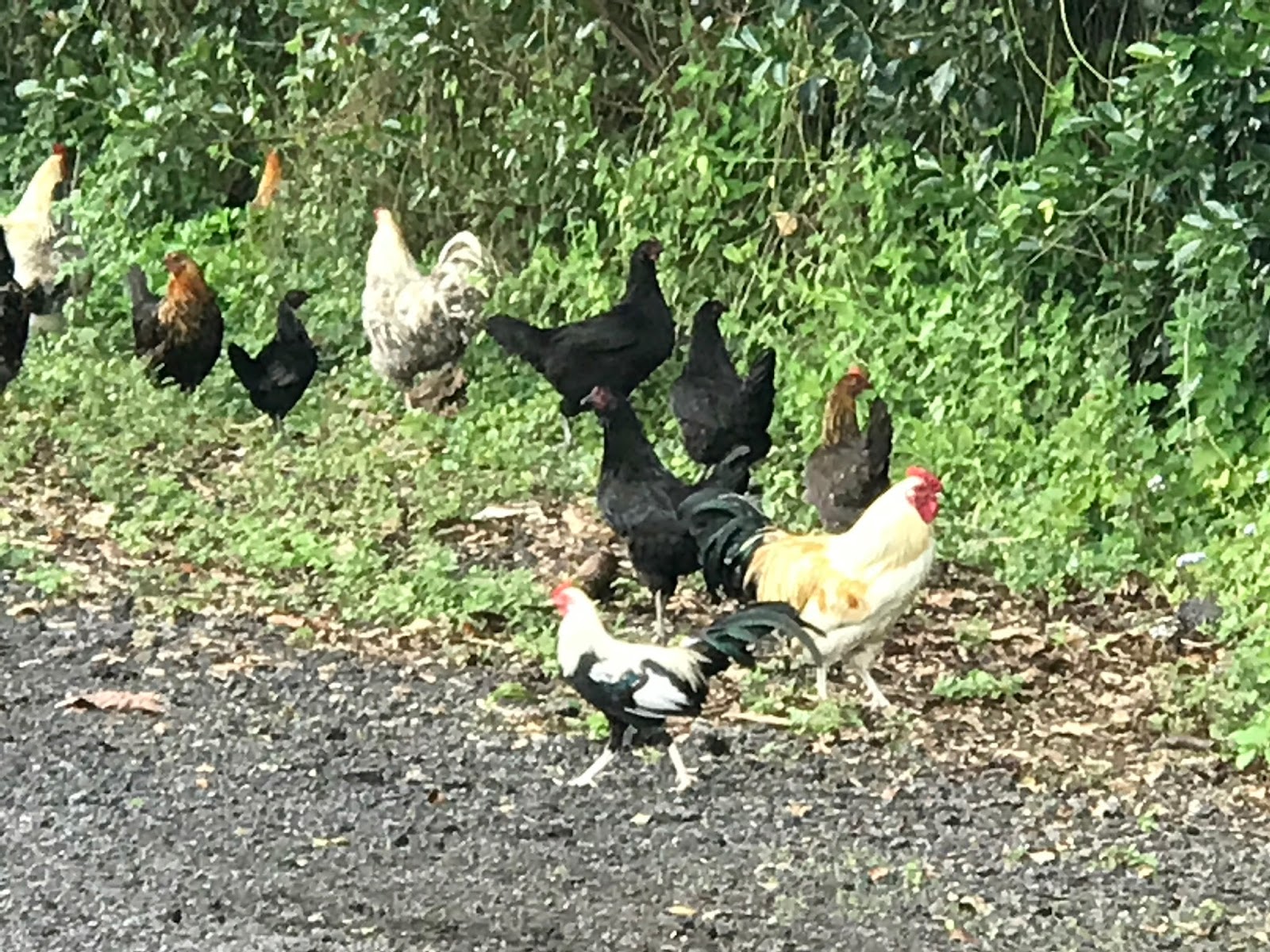
Finally, we got to Kalapana at the end of the road.  There used to be a village there, but it was destroyed by lava, so now there are just a bunch of people selling things.  It kind of sucked - we tried to eat lunch at a hippie-crunchy-granola place called Karuna Foods, but it appeared to be manned solely by someone dicing onions who felt no need to ask if we wanted to buy anything - which was just as well, since the menu didn’t really appeal. So we went back to where we started.  We took the fast route and not the scenic route, but we failed at not being scenic because we had to pull over after finding these guys:
Chickens are basically the bison of Hawaii
We found that because they live on the side of the road, we could get much closer to them in the car than on foot, because while they are afraid of people, they are used to cars.  Chickens!

Speaking of chickens and lunchtime, our guide at another stop mentioned that one day a friend of his got really bored and killed and ate a roadside chicken.  His friend's report was that it tasted terrible.  So, if you are in Hawai'i, our advice is not to eat chickens that are wandering by the road, unless you are very very hungry.

To get to our next destination, we had to loop around, and so we did go to Lava Tree State Park after all!  It is full of trees that have been engulfed by lava and so look like this:


The next stop was Isaac Hale Beach Park, where we went to pick up our boat tour in the operator’s homemade boat (it took them over a year -- to make the boat, I mean, not to pick us up.  You can tell because this entry is dated 2017).  

As a side note on time, I'd heard the expression "Hawaiian time" used at work to mean "keeping business hours that would make sense in the Hawaiian time zone" but people on Hawaii use it to mean "running behind schedule".  Despite this, pretty much tour we went on asked people to arrive at least 15 minutes early to "check in" and then started almost exactly on time; our lava boat tour actually left 15 minutes early.  But if we were on, say, a 15-person 2pm tour that actually left at 2:04pm, our guides would attribute this "lateness" to Hawaiian time.  Maybe it's just folks in the tourism industry trying to meet tourist standards, but it seemed like Hawaiians are in fact terrible at being late.  It was like what would happen if you told Germans to relax and not to worry about the timetable.

Anyway, back to the tour, where we first had 40 minutes of rollercoaster-like riding on massive swells — according to our guide, ancient Polynesians would use the swells to navigate, making sure that the swell hit their boat at the same angle to know they were going straight, and detecting that they were near land by changes in the swell patterns as waves bounced against the shore.  Along the way we spotted sights like perfectly round holes in the cliffside.  Can you guess what this is?

If you're having trouble figuring out what you're supposed to be looking at in this photo, click on it to enlarge it, then look for the hole in the middle of the cliff.  Or you could look at the screen and shout "enhance!", I hear that works too.


Answer: It’s a lava tube, the former ocean entry point of the lava flow.

You would probably do better at identifying the modern day ocean entry, which looks like this:


Although our view was mostly huge clouds of steam, we did get to see some red-hot lava oozing into the ocean. Other observations: jets of brand-new rocks hitting the water and being kicked up into the air, like a series of muddy splashes; more pumice-like rocks hitting the water and floating, leaving trails of steam in their wake; a weird not-quite-sulfur smell that helped make everyone seasick; the “bonk” sound of volcanic rocks that had been flung into the water floating upwards under the boat and hitting the hull.

After the boat tour it was time to go home.  In part to protect Mauna Kea from light pollution, the island has limited street lighting — what we did see was generally LED lighting, highly directional and pointed straight down.  Some of the older lights are sodium vapor instead, and produce an effect exactly like that of the Exploratorium’s Monochromatic Room (which also uses sodium vapor lighting), washing away all colors in the areas they light.  The road to Volcano, despite being a major route, has no streetlights, but Alex was continually impressed by the high quality reflectors. They were really good!

Tuesday, May 2, 2017

Day 1822: Into the Volcano


The very first thing we did in the morning was visit the Thurston Lava Tube.

I told Alex that the tube gets crowded, but he is skeptical.  After all, we went there at 9am and it looks like this:


Outside the tube we also see a bunch of honeycreepers that are red, and trees with roots hanging in the air.  There are 50 types of  honeycreepers and other finches on Hawai’i, all evolved from a single variety of finch.  We learned that in the video at the visitors center, where we will rest after going on a hike.  But now I am telling the story out of order.

Next stop is Kilauea Iki hike.  It goes through the jungle, then across a volcanic crater.  

What a lovely forest trail!

Wait, we aren't really hiking down and across that, are we?

In the jungle, we see a bird with a red head, with a plume like a quail.  It doesn’t mind us very much.  


Walking down to the crater is verry treacherous, but at the bottom we are rewarded with crazy terrain and some of Pele’s hair, thin strands of lava that do indeed look just like blonde hair.  (The Hawaiians seem to attribute lots of volcano related stuff to different parts of Pele — the sulfur that crystallizes outside of steam vents is even Pele’s piss.)   

OK, technically the caption said the translation was "Pele's waste", but come on.


Another exciting part was finding a steam not-quite vent.  When you were quiet and crouched low to the ground, you could hear the steam flowing underground, which sounded like sand flowing through an hourglass.  The ground was also notably hotter there than elsewhere — I almost burned my hand touching the rock. 

Life, uh, finds a way
The hiking boots were a good investment
 
Steam not-quite vent.  Hot hot hot!


The terrain was pretty rocky and tricky but the group in front of us was wearing flip-flops so maybe it wasn’t as bad as we thought.  After hiking out of the crater (estimated elevation gain based on how the hike felt: 1 million feet) we were very hungry, so it was time for lunch.  We went to a vegetarian cafe and sat in the yard, which was also home to the owner’s pet rabbit, who is bigger than our cat and seems to share at least one hobby with her (laying in the sun and doing nothing).  The owner is also an artist and there was a really cool gallery with all kinds of jewelry, housewares, and prints.  The ribbon scarf, apparently designed to allow accessorizing with a scarf in a climate where the temperature rarely drops below 50 degrees, seems to be a signature item, although the only thing we got was loofah soap. (Later we discovered that ribbon scarfs were available elsewhere on the island.)

After lunch, we went to the visitors center where we saw an introductory film about Hawai’i and I only slept through very small portions of it.  We learned that the squirrel-like critters we saw darting across the road were mongoose, and that they had been introduced to Hawai’i to eat rats.  However, it turns out that mongooses don’t eat very many rats (they are diurnal, rats are nocturnal) and also they eat eggs of native birds.  It seems like this plan was not really thought through.  We also learn that because Hawai’i has no native grazing animals, plants lose their defense mechanisms — raspberries have no thorns, and mint doesn’t taste minty. In conclusion, if you care about good food, you should be a fan of arms races.

The Big Island is known as the "Orchid Isle" despite the fact that only three varieties of orchid are native to it.  Although I never got a very clear explanation of what it means for something to be native to Hawaii.

Next we drove Chain of Craters Road, going through and rating the craters.  This crater gets an A:


This crater gets a D:

This crater gets an “incomplete”:

It was kind of unclear whether it was a crater or a ditch

We admired the nice new pavement on Chain of Craters Road.  I guess it was because they had to redo the road recently...I suppose the reason might have had something to do with this?
There were a bunch of lava fields on the side of the road but lava fields at this point are like buffalo to us — we don’t stop for them.
zzzz


Yawnsville!

Tuesday, April 25, 2017

Day 1821: To Hawaii!

To Hawaii!

Continuing our tradition of taking roadtrip vacations, Alex and I have now ventured to Hawaii. What’s that, you say? You can’t get to Hawaii via car? Well, fine. That’s true - we did fly here. But we have in fact rented a car to drive ourselves around the Big Island.

Upon landing in Hawaii, wee were immediately struck by the open air concourse at the airport, with gardens where you can wait for your flight, and birds flying up to the gates. It was the least-sterile-feeling airport I’ve flown through.

After hopping islands over to Hilo, picked up our rental car to start our road trip. The Hilo airport is tiny - not quite as small as New Haven’s 2-gate Tweed airport, but it was Tweed after eating a Mario mushroom. The parking lot is literally across the street from the airport.

We immediately headed down to our hotel (if you can call it that) - the Volcano Rainforest Retreat. Here, be jealous:


Not content to enjoy our lodgings, we went out to Volcano National Park to view the Halema'uma'u Crater. This turned out to be a good idea because - unlike most days - we actually got to see lava sloshing around in the crater:


Of course, since it’s an active volcano and the park service isn’t crazy, you only get to look at it from half a mile away.

At night, it becomes glowy. Fortunately, we got there just as nightfall was setting in, so we got to contrast the “boring” daytime version with the nighttime “glowy” version:


That was about it for us on the first day of the trip - it turns out that being 3 hours offset makes you really tired at an absurdly early hour.